The MIND Diet: How to Apply the Most Researched Brain-Health Diet to Sharpen Performance, Focus, and Decision-Making at Work
By Douglas Chironno, M.S., RDN, CPT — The Nourishing Brief, DougFit.com
The research on the MIND diet is compelling: consistent adherence has been associated with up to a 53% reduction in Alzheimer’s risk, with even moderate adherence reducing risk by approximately 35%. A deeper dive into studies on some of the recommended foods has also been linked to mental cognition of 2.5 to even 11 years younger.
But like most health studies that stop at disease prevention, this framing misses something important for the generally well population — lifestyle and nutrition optimization for cognition and mental clarity.
The same nutritional mechanisms that protect the brain over decades are the same ones that can optimize it.
For high performers and anyone whose livelihood depends on the quality of their thinking — that distinction is the difference between treating nutrition as healthcare and treating it as a necessary performance system.
What Is the MIND Diet?
The MIND diet — short for **Mediterranean-DASH Intervention for Neurodegenerative Delay** — developed by Dr. Martha Clare Morris and her team at Rush University and first published in 2015. It’s a hybrid of two of the most well-validated dietary patterns in clinical nutrition:
- The Mediterranean diet, recognized for its cardiovascular benefits and emphasis on olive oil, fish, vegetables, and whole foods.
- The DASH diet (Dietary Approaches to Stop Hypertension), originally designed to lower blood pressure through reduced sodium and increased plant-based foods — and long considered the standard cardiovascular nutrition framework.
What makes the MIND diet distinct isn’t that it borrows from both — it’s that it was specifically refined around the foods and nutrients most associated with brain protection, not general health outcomes.
Most health frameworks ask: Will this help me live longer? The MIND diet asks something far more specific:
Will this keep my brain functioning at a higher level, longer?
That’s a performance question. And the answer has immediate, practical applications for anyone that thinks with their mind.
Your Brain Is a High-Demand Organ — Treat It Like One
Your brain represents roughly 2% of your body weight but consumes approximately 20% of your daily energy. Disrupt any input — even briefly — and performance degrades.
Three factors drive most of what we experience as “off days” cognitively:
Blood sugar volatility — spikes and crashes translate directly into attention lapses, decision fatigue, and slowed processing within hours of eating.
Chronic low-grade inflammation— narrows blood vessels and reduces cerebral blood flow, dulling everything from recall to verbal fluency.
Compromised cellular structure — when your diet lacks the right fats, the integrity of your neurons themselves weakens over time.
The MIND diet addresses all three simultaneously. That’s what makes it a legitimate performance framework — not just a longevity protocol.
The Core Foods and function
Below are the food categories the MIND diet emphasizes, the research behind each one, and how to translate them into a working professional’s routine.
🥬 Dark Leafy Greens
MIND target: At least 1 serving per day.
One serving = 1 cup raw greens or ½ cup cooked. A standard side salad, the spinach folded into your morning eggs, or a handful in a smoothie all qualify.
The Rush Memory and Aging Project found that just one serving per day of leafy greens like spinach, kale, or arugula was associated with cognitive function equivalent to being approximately 11 years younger in brain age!
The active compounds — phylloquinone (vitamin K1), lutein, folate, nitrate, and kaempferol — support vascular health, reduce oxidative stress, and protect neuronal integrity.
Cognitive application: A daily green base maintains the infrastructure your brain runs on. Spinach folded into morning eggs, an arugula side at lunch, or a handful of kale in a smoothie all count.
🫐 Berries
MIND target: 2 or more servings per week (fresh or frozen — not dried).
One serving = ½ cup. Roughly a small handful of blueberries, or the amount that fits in a standard espresso cup.
Berries — particularly blueberries — are rich in “anthocyanins”a class of flavonoids that actually cross the blood-brain barrier and concentrate in regions associated with memory and learning.
A 2012 study from the Annals of Neurology tracking over 16,000 women found that higher long-term berry intake was associated with slower memory decline — by an estimated 2.5 years.
Cognitive application: Berries are the single most actionable swap. Replace the mid-morning pastry with a half-cup of blueberries and Greek yogurt. The shift in afternoon focus is often noticeable within a week.
🌾 Whole Grains
MIND target: 3 or more servings per day.
One serving = ½ cup cooked grains (quinoa, farro, brown rice, oats) or 1 slice of 100% whole grain bread. A normal grain bowl base is typically 1–2 servings on its own.
The brain runs almost exclusively on glucose. The question isn’t whether you need carbohydrates — it’s whether you’re delivering them in a form that produces a steady supply or a series of crashes.
Research on glycemic load and cognitive function consistently shows that lower-glycemic, higher-fiber carbohydrate sources support more stable attention and executive function across the workday.
Cognitive application: Replace refined white rice, white bread, and most cereals with steel-cut oats, quinoa, farro, brown rice, or 100% whole grain bread. The goal isn’t carb avoidance — it’s carb selection.
🥜 Nuts
MIND target: 5 or more servings per week.
One serving = roughly ¼ cup, or what fits in a closed palm.
The landmark PREDIMED study found that a Mediterranean diet supplemented with nuts produced significantly better cognitive scores than a low-fat control diet over several years of follow-up.
Nuts deliver vitamin E, monounsaturated fats, polyphenols, and magnesium — all of which support vascular health and reduce neuronal inflammation.
Cognitive application: A small handful of mixed nuts (walnuts, almonds, pistachios) as a mid-afternoon snack stabilizes blood sugar and provides 4–5 grams of protein and healthy fats — the kind of input that keeps the 3 PM slump from becoming a meeting derailer.
🫘 Beans
MIND target: 3 to 4 servings per week.
One serving = ½ cup cooked beans or lentils. The amount you’d find in a typical lunch bowl side or a cup of hearty soup.
Beans are perhaps the most overlooked category on the list. They’re a low-glycemic carbohydrate source, a plant-based protein, and a major fiber contributor — all in one.
The fiber feeds gut microbes that influence the gut-brain axis, while the slow-release carbohydrates support sustained mental energy without the spike-and-crash pattern of refined starches.
Cognitive application: Black beans in a lunch bowl. Lentils in a soup. Chickpeas roasted as a snack. The point isn’t to become vegetarian — it’s to add a category most professionals skip entirely.
🐟 Fatty Fish — Structural Brain Support
MIND target: 1 or more servings per week, with emphasis on fatty fish.
One serving = 3 to 4 ounces, roughly the size of a deck of cards or the palm of your hand. A standard restaurant filet is usually 1.5–2 servings.
Omega-3 fatty acids — specifically DHA and EPA — aren’t just nutrients. They’re literally structural components of brain cell membranes.
A 2014 study published in Neurology found that higher fish consumption was associated with greater gray matter volume in brain regions critical to memory.
Cognitive application: Wild salmon, sardines, mackerel, herring, or trout once or twice a week. If you don’t eat fish, a high-quality fish oil supplement (vetted for purity) is a defensible substitute — but aim for food first.
🍗 Poultry — Lean Protein Selection
MIND target: 2 or more servings per week.
One serving = 3 to 4 ounces of cooked chicken or turkey, again about the size of a deck of cards or your palm.
The MIND diet doesn’t treat all animal protein equally. Lean poultry replaces red meat as the default protein source, primarily because lower saturated fat intake is associated with reduced inflammation and better vascular health — both of which influence brain function.
Cognitive application: Grilled or roasted chicken and turkey instead of frequent burgers, steaks, or processed meats. Red meat doesn’t need to disappear — but it should be a feature, not a default.
🫒 Extra Virgin Olive Oil
MIND target: Use as your primary added fat (approximately 2 tablespoons per day).
A tablespoon is about three quick drizzles around a salad bowl or what coats a sauté pan. Two tablespoons is realistic if EVOO is your default cooking and finishing fat.
Extra virgin olive oil (EVOO) is rich in oleocanthal and other polyphenols that exert anti-inflammatory effects comparable to ibuprofen at the cellular level. It also supports vascular health, which directly affects cerebral blood flow.
In the PREDIMED study mentioned earlier, the olive oil group showed cognitive benefits comparable to the nut group — consistent improvements over several years compared to a low-fat control.
Cognitive application: Use EVOO as your default cooking and finishing fat. Drizzle it on salads, vegetables, fish, and grain bowls. The key word is extra virgin— refined olive oils may work but lose most of the polyphenols that drive the benefit.
🚫 What to Limit — Just as Important as What to Include
The MIND diet is equally specific about what to **minimize**:
- Butter and margarine (fewer than 1 tablespoon per day)
- Cheese (less than once per week)
- Red and processed meats (fewer than 4 servings per week)
- Fried foods (less than once per week)
- Pastries and sweets (fewer than 5 servings per week)
These aren’t moralistic restrictions. They’re targeted because saturated fat, trans fat, and added sugar drive the inflammation, insulin resistance, and vascular dysfunction that erode cognitive function over time.
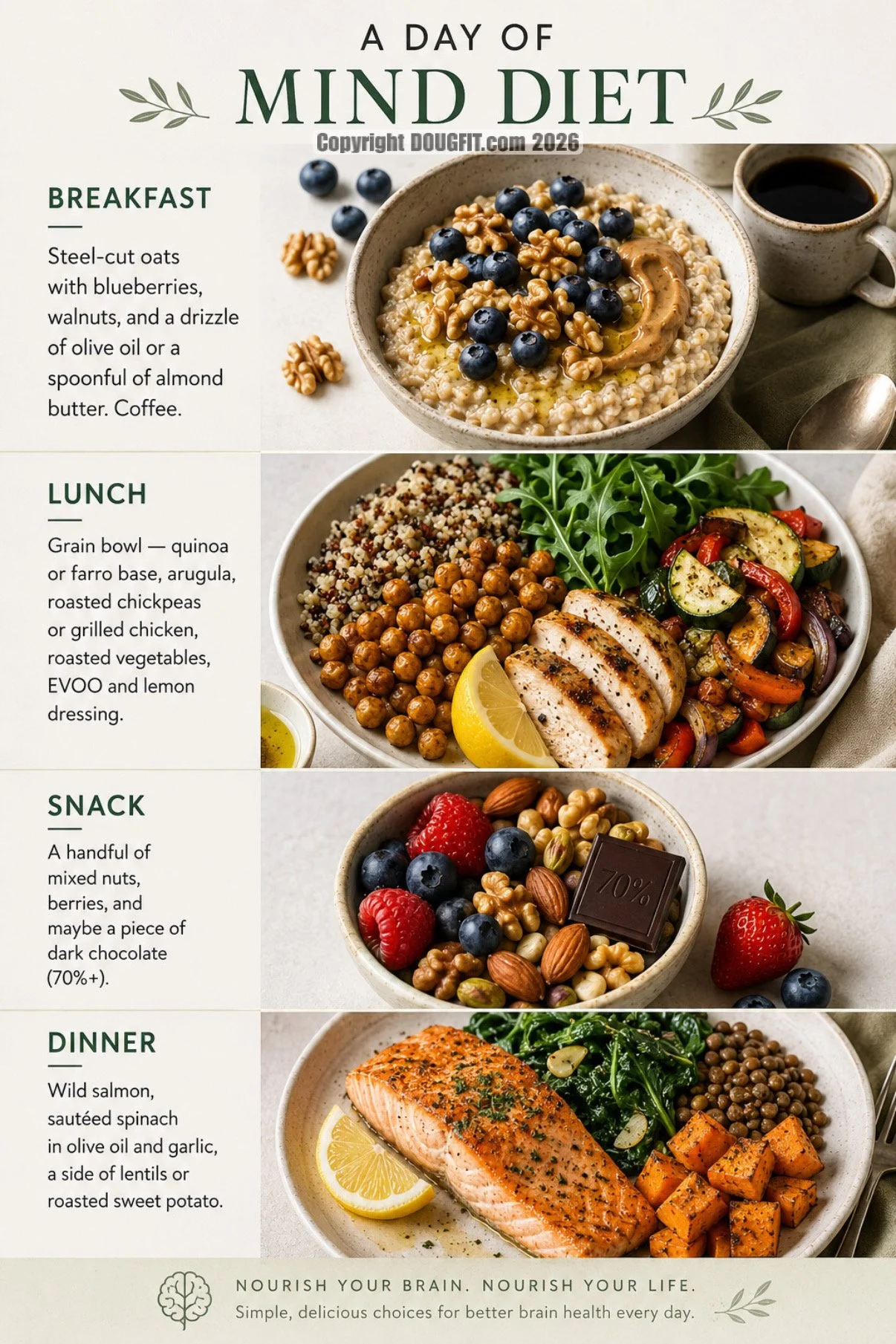
A Sample Day on the MIND Diet — Built for a Busy Professional
This isn’t a meal plan. It’s a template.
Breakfast: Steel-cut oats with blueberries, walnuts, and a drizzle of olive oil or a spoonful of almond butter. Coffee.
Lunch: Grain bowl — quinoa or farro base, arugula, roasted chickpeas or grilled chicken, roasted vegetables, EVOO and lemon dressing.
Snack: A handful of mixed nuts, berries, and maybe a piece of dark chocolate (70%+).
Dinner: Wild salmon, sautéed spinach in olive oil and garlic, a side of lentils or roasted sweet potato.
Total time investment: less than most professionals spend deciding what to order on a delivery app.
Putting It Into Practice
A simple 30-day starting framework:
- Daily: Leafy greens, extra virgin olive oil, whole grains
- 5+ times per week: Nuts, berries
- 3–4 times per week: Beans
- 1–2 times per week: Fatty fish
- 2+ times per week: Poultry as your default animal protein
- Limit: Red meat, butter, fried foods, pastries, and processed snacks
You don’t need to be perfect. The original Morris research showed that even moderate adherence produced significant cognitive benefit. The point isn’t to overhaul your life — it’s to install a pattern your brain can run on.
How you eat is how you think. And how you think is how you perform.
Douglas Chironno, M.S., RDN, CPT, is a Registered Dietitian Nutritionist and Certified Personal Trainer. He trains and coaches high performing CEOs and Founders learn more at https://www.dougfit.com/executive-program
References
- Morris, M.C., et al. *MIND diet associated with reduced incidence of Alzheimer’s disease.* Alzheimer’s & Dementia, 2015.
- Morris, M.C., et al. *Nutrients and bioactives in green leafy vegetables and cognitive decline.* Neurology, 2018.
- Devore, E.E., et al. *Dietary intakes of berries and flavonoids in relation to cognitive decline.* Annals of Neurology, 2012.
- Valls-Pedret, C., et al. *Mediterranean diet and age-related cognitive decline (PREDIMED).* JAMA Internal Medicine, 2015.
- Raji, C.A., et al. *Regular fish consumption and age-related brain gray matter loss.* American Journal of Preventive Medicine, 2014.