How Finance Professionals Stay Fit During 80-Hour Work Weeks | DougFit
By Douglas Chironno, M.S., RDN | Registered Dietitian & Performance Coach | DougFit
If you work in finance, you already know the pattern.
The pressure builds for a deadline so you show up early. Deals close late. The week that was supposed to be manageable turns into 80, 90, sometimes 100-hour stretches. And somewhere in there, the gym becomes the first thing that gets cut.
Not because you don’t care about your health. Because there are only so many hours in a day.
I have worked with finance professionals in Manhattan for over a decade — CEOs, managing directors, legal counsel, financial analysts, portfolio managers, and product developers — many of whom were former athletes who take their physical condition seriously. The challenge for them is never motivation. It’s logistics and structure. It’s knowing what to prioritize when everything is competing for the same hours.
Here’s what actually works, clinically and practically.
1. Stop Treating the Gym Like an All-or-Nothing Commitment
Think of it like an athlete’s on and off season. You need a game plan for the intense weeks — a “defense” — and a ready-to-go “offense” for when you finally get space to focus on yourself.
The biggest mistake high-performing professionals make is building a perfect fitness routine that assumes consistent blocks of time. Then when the week blows up — and it will — the routine collapses entirely. With it goes the momentum, and something more consequential: the principle of reversibility.
The Principle of Reversibility
Your body is highly adaptive and seeks efficiency. Maintaining muscle mass and cardiovascular capacity requires significant energy, so the body will begin dismantling these systems if they aren’t being used — much like how astronauts atrophy in space. This process can begin faster than most people realize.
The Minimum Effective Dose
Science shows that maintenance requires far less effort than improvement. While building muscle or increasing VO2 max demands high training volume, you can preserve most of your gains with a fraction of that work.
Short, low-volume maintenance sessions — the Minimum Effective Dose (MED) — help preserve neuromuscular adaptations and significantly slow detraining compared to complete inactivity. Research supports this: Iversen et al. (2021) found that even substantially reduced training frequency can maintain strength and hypertrophy adaptations when intensity is preserved.
For most of my clients, the MED during a demanding week looks like 20–35 minutes of focused daily movement — a run with some push-ups, a bodyweight circuit, resistance band work, or a brief strength session. Some studies suggest even 10–15 minutes of focused exercise provides measurable benefit. Is this as effective as an ideal 60-minute session? No. But we are playing defense.
The goal during these weeks isn’t improvement — it’s not losing ground. Stay disciplined with your MED and you’ll be ready to go on offense the moment your schedule opens up.
Does this sound familiar?
What I commonly see: someone finally gets a break, loses a few pounds, starts feeling like themselves again — and then the next demanding cycle hits. They’re exhausted, the gym gets cut again, and they’re back at square one.
The fix is a plan. Set your minimum effective dose. Treat it as non-negotiable.
When the week allows more, do more. When it doesn’t, hit your floor and protect what you’ve built.
2. Visualize, Plan, Execute
For the MED to work, it needs a specific time and place — not a vague intention.
My recommendation for most clients is first thing in the morning, before the day and emails begin. If that genuinely won’t work, spend five minutes the night before visualizing exactly what exercise you will do and precisely when you will do it. Schedule it like a meeting.
Fail to plan, plan to fail. If you have to move it, move it — but never skip the step of setting a specific time and place. That five-minute commitment the night before is what separates clients who maintain their condition from those who don’t.
3. Nutrition: Where Most Professionals Lose the Most Ground
Long hours mean skipped meals, fast lunches, client dinners, and decisions made when you’re already depleted. This is where physique goals get quietly sabotaged.
Just like the MED principle in training, you need a nutrition minimum during demanding weeks. That means:
∙ A default breakfast that takes five minutes and is non-negotiable — protein forward, no decisions required.
∙ A healthy snack within reach at your desk — something that keeps your metabolism engaged and prevents the energy crashes that lead to poor decisions later.
∙ A client dinner strategy — not about ordering a salad while everyone else eats, but about knowing your default choices so you’re not making decisions from a depleted state.
The professionals I work with who maintain their physique through demanding periods share one thing: a simple, repeatable framework that doesn’t require willpower or perfect conditions. We build that framework together, specifically around their schedule, their regular restaurants, and their travel patterns.
4. The Accountability Variable
Here’s what separates professionals who maintain their condition through demanding stretches from those who don’t: they have someone who understands their world.
Apps don’t do this. Generic programs don’t do this. A trainer who prescribes six days a week without understanding what your week actually looks like isn’t coaching you — they’re prescribing the wrong dose.
The right coach builds a system around your actual life. When the week blows up, you have a plan. When the client dinner runs late, you know what to order. When you’re traveling, you know exactly what to do. That’s what genuine performance coaching looks like for someone operating at your level.
The Bottom Line
Staying in peak physical condition during intense work weeks isn’t about working harder in the gym. It’s about being smarter with the time and energy you have — and having a proven framework that adapts to your reality rather than fighting it.
This is exactly what the DougFit Executive Program is built around.
If you’re a finance professional or executive in New York who is serious about your physical performance and wants a trainer and registered dietitian who understands the demands of your world — I work with a small number of clients at this level.
Sources
Iversen, V.M., Norum, M., Schoenfeld, B.J., & Fimland, M.S. (2021). No Time to Lift? Designing Time-Efficient Training Programs for Strength and Hypertrophy. Sports Medicine, 51, 2079–2095. https://pmc.ncbi.nlm.nih.gov/articles/PMC12183069/
Aslam, S. Neuromuscular Adaptations to Resistance Training in Elite Athletes: A Critical Review. 2025, https://pmc.ncbi.nlm.nih.gov/articles/PMC12183069/

How to improve posture at work: Fix your desk posture, ergonomics. Evidence based tips and stretches
Sitting at a desk all day can strain your neck and back. Learn simple posture tips and easy adjustments that improve comfort, boost energy and protect your long-term health at work.
Updated 2025
Introduction
If you spend long hours at your desk or laptop, you’ve probably felt the toll it can take on your posture, neck, and lower back. Research shows that poor ergonomics not only cause daily discomfort but also increase the risk of chronic musculoskeletal issues.
The good news? With a few simple adjustments and stretches, you can dramatically improve your posture, reduce strain, and stay comfortable throughout the day.

Poor posture results from hunching over screen
Hunched posture at the desk puts extra stress on the neck and lower back—caused by forward head tilt and tight hip angles
In this evidence based article by Douglas Chironno Certified Personal Trainer M.S. RDN
Common problematic posture habits from typical office set ups.
Easy to apply evidence based sitting corrections that that can decrease strain on your neck and back.
Simple and effective stretches you can do today to mitigate poor posture resulting from long hours of sitting.
1. Common Posture Problems in Modern Workspaces
1a. Screen too low
When your monitor or laptop sits below eye level, your head naturally leans forward. This “tech neck” posture shortens the chest and shoulder muscles while straining the neck and upper back.

1a. Lap top screen to low, forcing head down and shoulders tipped foward

Every 15 degrees of head tilt dramatically increases pressure on the neck. Source: “Assessment of Stresses in the Cervical Spine Caused by Posture and Position of the Head” - Kenneth K. Hansaraj, Surgical Technology International, Volume 25 (2014) pp. 277-279.
1b. Foward lean in chair : Hips < 90 degrees

1b. Without proper back support, many workers sit in a hunched-forward position. This tightens the hip flexors and pulls the lower back into an unnatural curve, often leading to discomfort or pain in the lower back. - From my experience of initial interviews, this is the #1 complaint I hear from lawyers and business professionals.
DOUGFIT’S
2. Simple Ergonomic Desk Fix

Image of professional seated with open hips ( not in acute angle) and laptop lifted up by book or brief case to allow for less of a forward hunch and head tilt.
2a. Overview: Optimized Desk Position
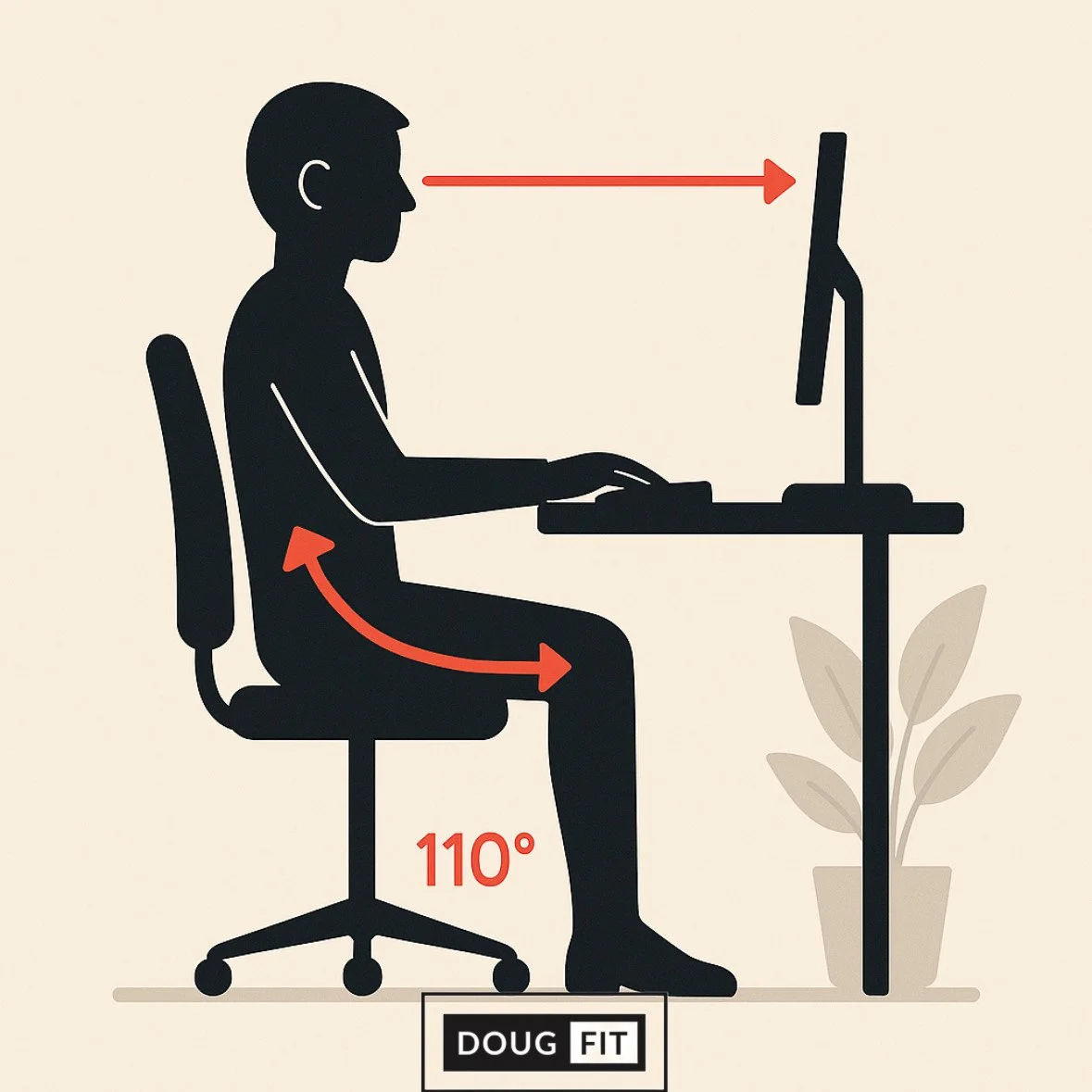
2a. The big picture: Optimized Seated Posture with illustration of angles for upper and lower body
2 b. Optimized head position

2 b. Optimized head and neck position for computer work, screen at eye level
2 C. Optimized hip position

2 c. Optimized seated position , hips greater than 90 degrees flexion - Support your back and open your hips: If your chair doesn’t provide upright support or lift, try adding a small pillow or cushion. This prevents over tightening of your hip flexors and eases stress on the lower back.
3. Quick effective stretches you can do at the office
3 a. Standing Hip Flexor Stretch

3a. Toe Touch with Straight Back: Bend at the hips (not the lower back), keeping your spine straight. This hamstring stretch reduces tension in the back and legs.
3b. Standing Hip Flexor Stretch

3b. Hip Flexor Stretch: Step one foot forward into a lunge, keeping your torso upright. Gently rock forward to open the hip. For help getting into the stretch; you can raise and slightly bend your opposite arm for use as a counterweight.
3c. Chest Opener Stretch
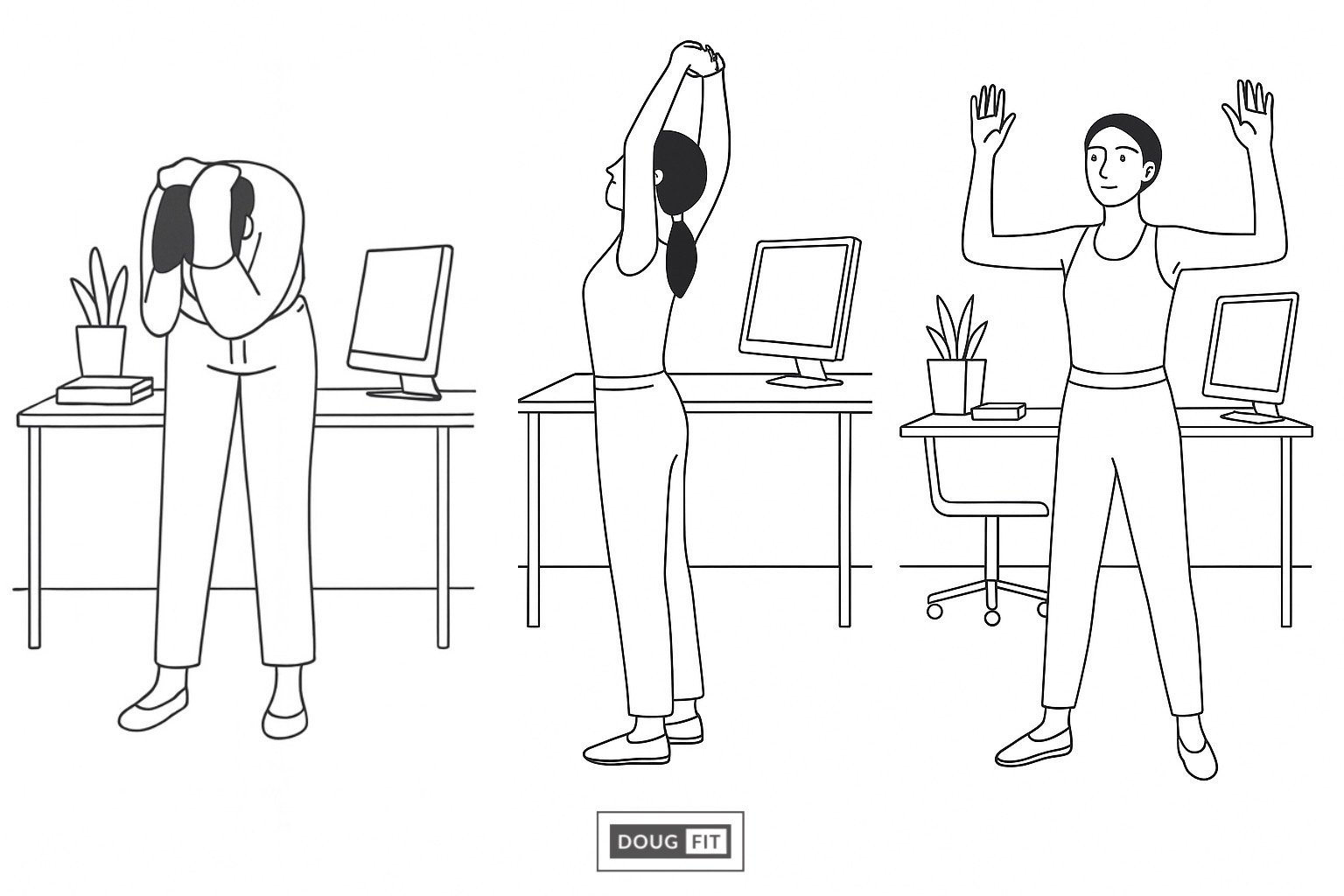
3c. Chest Opener: Raise your arms overhead with palms forward, then lower your elbows to your sides. This stretches tight chest and shoulder muscles.
*Remember: Every body is different. Consult your healthcare provider before making changes if you have existing pain or injuries.
Want personalized posture and mobility coaching?
DougFit works with professionals who need structured coaching
References:
Hansraj, K. K. (2014). Assessment of stresses in the cervical spine caused by posture and position of the head. Surgical Technology International, 25, 277–279.
Bridger, R. S. (1988). Postural Adaptations to a Sloping Chair and Work Surface. Human Factors: The Journal of the Human Factors and Ergonomics Society, 30(2), 237-247. https://doi.org/10.1177/001872088803000210 (Original work published 1988)
Shirouchi, T., Murata, S., Horie, J., & Uchiyama, Y. (2022). Effect of different seat heights on lumbar spine flexion during sit-to-stand and stand-to-sit. Journal of Physical Therapy Science, 34(1), 44–49. <Effect of different seat heights on lumbar spine flexion during stand-to-sit motion - PMC>