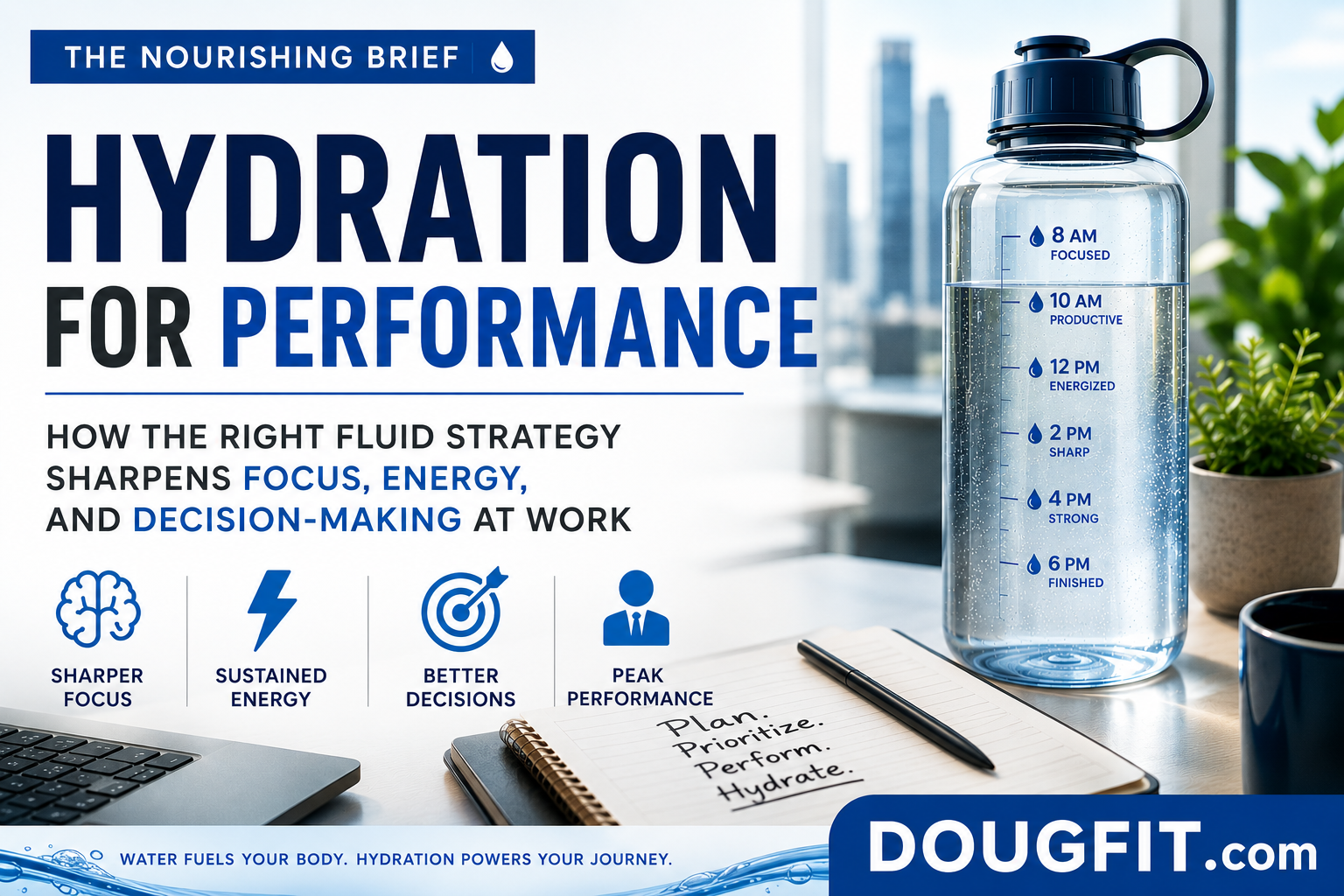
Hydration for Performance: How the Right Fluid Strategy Sharpens Focus, Energy, and Decision-Making at Work
Executive Health · Nutrition · Performance
By Douglas Chironno, M.S., RDN, CPT — The Nourishing Brief, DougFit.com
H2O The Hidden Performance Variable
The cognitive effects of hydration are more important than most professionals realize. A fluid loss of just 1–2% of body weight has been associated with measurable declines in attention, short-term memory, mood, and cognitive performance.
Despite this conversations about hydration usually stop at “drink more”—advice that lands somewhere between floss daily and get more sleep without providing an actual strategy.
For professionals whose performance depends on the quality of their thinking, knowing what is optimal matters.
Why Your Brain Is the First Thing to Go
Your brain is roughly 75% water, making it remarkably sensitive to changes in fluid balance. Unlike muscle, it has virtually no reserve to draw upon. As total body water declines, cognitive performance is often among the first systems to suffer.
Three primary mechanisms explain why even mild dehydration affects performance: Reduced cerebral blood flow, Impaired thermoregulation, Elevated cortisol and perceived effort
Reduced cerebral blood flow
Even mild dehydration decreases blood volume, reducing oxygen and glucose delivery to the brain. Processing speed slows, concentration wanes, and verbal recall becomes less efficient.
Impaired thermoregulation
Water is your body’s cooling system. Whether you’re navigating a crowded commute, sitting in a warm office, or attending a summer client lunch, fluid lost to temperature regulation is fluid no longer available to support other physiological processes.
Elevated cortisol and perceived effort
Dehydration acts as a physiological stressor. Tasks feel more difficult, mental fatigue develops sooner, and identical workloads require greater effort.
The result is something many professionals misattribute every day: the 3 PM mental fog blamed on lunch, the irritability blamed on a difficult meeting, or the second-guessed decision blamed on a long week. It’s the same energy and fatigue pattern I see in clients managing muscle loss on GLP-1s - An often overlooked variable is simply inadequate hydration.
The Thirst Problem: Why You Can’t Feel Your Way to Hydrated
Here’s what undermines most people’s instinct to “just drink when I’m thirsty”: thirst is a lagging indicator.
By the time you consciously feel thirsty, you’ve often already experienced enough fluid loss to affect cognitive performance. The busier your day becomes, the worse this problem gets. Deep focus and outward attention suppress thirst cues, which is why productive mornings often become dehydrated mornings.
Coffee deserves clarification as well. Contrary to popular belief, moderate coffee consumption contributes meaningfully to daily fluid intake in habitual coffee drinkers. The problem isn’t that coffee dehydrates you—it’s that coffee frequently replaces water instead of complementing it.
Four cups of coffee and no water by noon isn’t a hydration strategy. It’s a formula for fluid deficit.
The solution isn’t greater willpower—it’s creating a system that removes the need to rely on thirst altogether.
How Much Water Do You Actually Need?
The familiar “eight glasses a day” rule is a helpful memory aid—but a poor prescription.
Fluid requirements vary based on body size, physical activity, climate, medications, and overall health.
The National Academies of Sciences, Engineering, and Medicine, referenced by the Academy of Nutrition and Dietetics, recommends total daily water intakes of approximately:
Men: 125 oz (3.7 L; ~15.5 cups)
Women: 91 oz (2.7 L; ~11.5 cups)
These recommendations include water from both beverages and foods. Soups fruits salads ect. Because food typically provides approximately 20% of daily water intake, beverage needs are lower.
By comparison, guidance from the European Society for Clinical Nutrition and Metabolism (ESPEN), based on European Food Safety Authority (EFSA) recommendations, suggests actual beverage intakes of approximately:
Women: 1.6 L/day (~7 cups)
Men: 2.0 L/day (~8½ cups)
Taken together, a practical daily target for generally healthy adults is:
Women: approximately ~8–11 cups of beverages per day
Men: approximately ~9–13 cups of beverages per day
Needs are of course increased during hot weather, travel, illness (particularly vomiting or diarrhea), alcohol consumption, or exercise.
Replacing Fluid After Exercise
According to the American College of Sports Medicine, adults should replace approximately 125–150% of the fluid lost during strenuous exercise, or roughly 20–24 ounces of fluid for every pound of body weight lost. For reference thats about 1.5x a standard 16oz water bottle.
In practice, many athletic trainers and fitness professionals use a simpler field recommendation of 16–24 ounces per pound lost, adjusting upward for prolonged exercise, heavy sweating, or hot environments. When sweat losses are substantial, replacing electrolytes alongside fluids becomes increasingly important.
A Simple Hydration Check
One of the simplest field assessments remains one of the best.
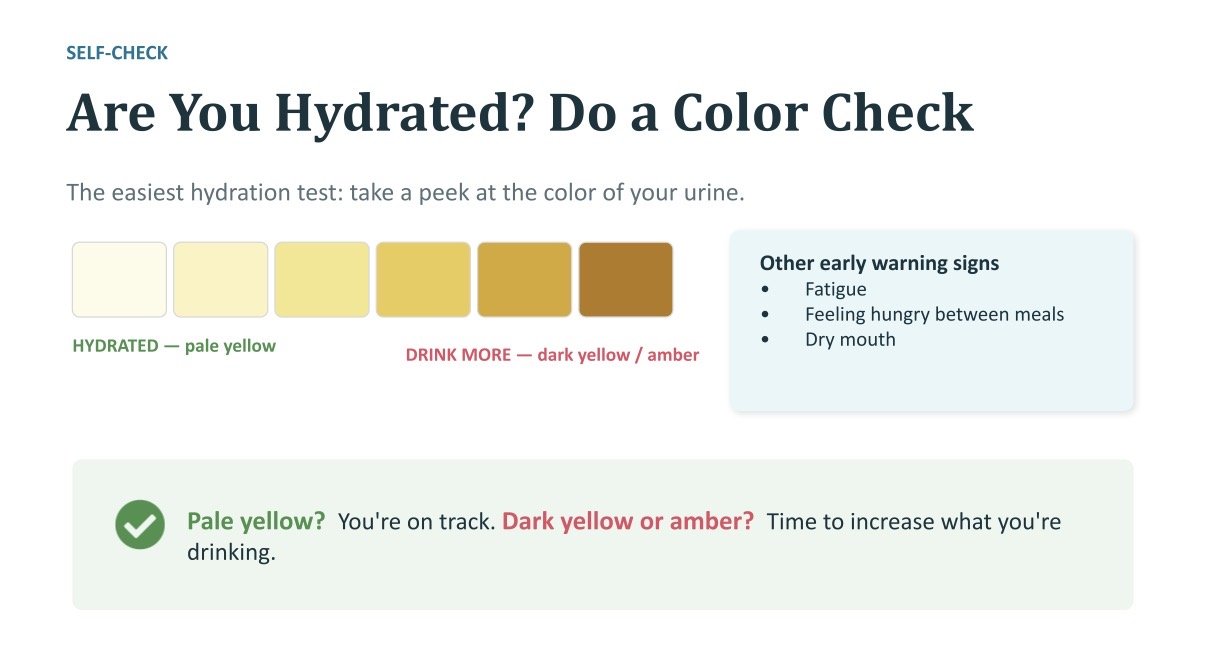
Your urine should generally be pale yellow.
Dark yellow or amber urine often indicates you’re behind on fluids. While not perfect, urine color is an inexpensive, practical tool that is far more useful than many hydration trackers.
Electrolytes: When Water Alone Isn’t Enough
Electrolytes—including sodium, potassium, magnesium, and calcium—allow your body to effectively regulate fluid balance, transmit nerve impulses, and support normal muscle function.
For most office-based professionals, a balanced diet adequately replaces daily electrolyte losses.
However, needs increase after prolonged sweating, endurance exercise, gastrointestinal illness, travel, or excessive alcohol intake.
In these situations, replacing large fluid losses with water alone may not fully restore hydration status and, in prolonged endurance events, excessive water intake without sodium can contribute to dilution of blood sodium levels.
Fortunately, most people don’t need a cabinet full of supplements.
Food should be the first strategy.
Potassium: bananas, potatoes, beans, yogurt
Magnesium: nuts, seeds, spinach
Sodium: broth, soups, lightly salted foods
Electrolyte supplements can be useful after prolonged or high-intensity exercise, but they’re unnecessary for most routine workdays.
Eat Your Water
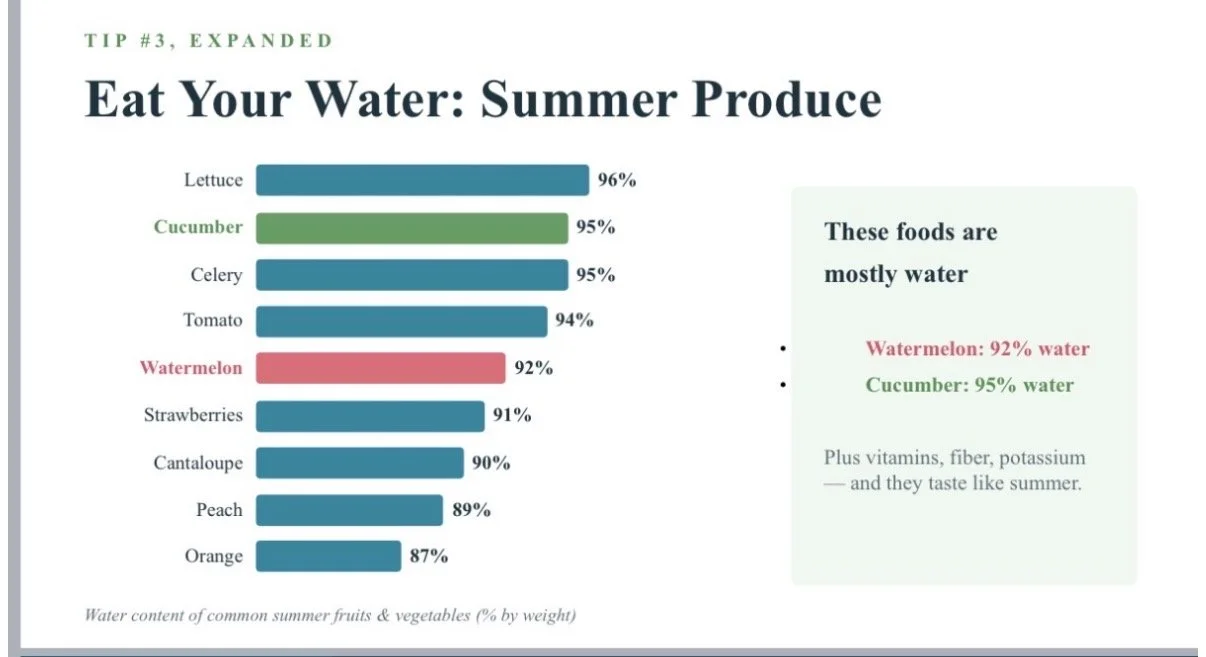
One of the most overlooked hydration strategies is also one of the easiest: eat water-rich foods.
Unlike beverages alone, fruits and vegetables provide water alongside fiber, potassium, antioxidants, and vitamins.
Approximate water content:
Cucumber — 95%
Lettuce — 96%
Celery — 95%
Tomato — 94%
Watermelon — 92%
Strawberries — 91%
Cantaloupe — 90%
Orange — 87%
Adding a side salad, fruit with an afternoon snack, or vegetables to lunch quietly contributes meaningful fluid throughout the day without requiring another conscious sip.
A Working Hydration System for Busy Professionals
On waking
Drink a full glass of water before your first coffee. After 7–8 hours without fluids, begin the day by replenishing what you’ve lost overnight.
At your desk
Keep a water bottle within arm’s reach. Visibility dramatically increases intake.
Before meals
Drink one glass of water before breakfast, lunch, and dinner.
With coffee
Pair your second and third coffee with a glass of water. ( this is also a good strategy for alcohol).
At lunch
Include at least one water-rich fruit or vegetable.
After heavy sweating
Replace fluids and electrolytes using food first and supplementation when appropriate.
Performance Takeaways
Hydration isn’t simply about preventing dehydration—it’s about supporting consistent cognitive and physical performance throughout the day.
Maintaining adequate hydration has been associated with:
Better attention and concentration
Reduced mental fatigue
Improved decision-making
More stable mood and energy
Improved exercise recovery
Fewer afternoon productivity declines
For professionals, these small advantages compound over months and years. Paired with brain supportive eating patterns like the MIND diet, hydration becomes part of a complete performance strategy.
The Bottom Line
Hydration is one of the few performance variables that is free, completely within your control, and consistently underappreciated.
You don’t need to obsessively track ounces or purchase expensive products.
You simply need a handful of habits that make adequate hydration the default rather than the exception.
How you hydrate influences how you think.
And how you think influences how you perform.
Douglas Chironno, M.S., RDN, CPT, is a Registered Dietitian Nutritionist and Certified Personal Trainer who coaches executives, entrepreneurs, and professionals seeking to optimize health, performance, and longevity.
Learn more about Executive Nutrition & Performance Coaching at DougFit.com.